How to Manage More Social Media Clients Without Burning Out: a Working Guide
Every solo social media manager hits the same ceiling, and it isn’t a talent ceiling. It’s arithmetic. This guide is about moving the arithmetic: how to onboard clients so their knowledge stops living in your head, how to end the “client never sends anything” famine, and where AI tools for social media managers genuinely fit in the workflow. Full disclosure before we start: our team builds Laspi, an AI production tool for exactly this job. The guide is useful whether or not you ever touch it.
The ceiling: why growth stalls at the same client count
Run an honest audit of one full-service client and the hours usually split three ways. Strategy and planning take a few hours a month. Communication, approvals and community take a few more. And production, the ideas, the copy, the visuals, the scheduling, quietly eats the majority: for most managers it’s well over half of every retainer.
That’s why the ceiling exists. Strategy hours and relationship hours don’t compress: they are the actual job, the judgment clients pay for. Production hours are the only compressible mass in the schedule. A social media manager who wants to manage more clients has exactly three levers: hire help and give away the margin, raise prices and lose the price-sensitive half of the roster, or change the production model. This guide is about the third lever.
Onboarding: capture the client’s brain once, properly
The standard client questionnaire fails in a predictable way: clients don’t fill it in, or they fill it with fiction (“our tone is professional but friendly”, which describes every business on Earth). What works is extraction instead of homework.
Replace the questionnaire with a recorded onboarding interview, thirty to forty minutes, and mine it for a per-client knowledge file:
- Offers and prices, with what’s actually included.
- The five questions their clients ask most, in the clients’ wording.
- The objections: too expensive, I’ll do it myself, maybe later, and how the owner answers each.
- Two or three cases with real numbers.
- The audience described in the owner’s words, not demographic brackets.
- Constraints: promises they never make, humor they don’t do, topics that are off the table.
This file is your professional moat. When the client asks why your retainer costs what it costs, part of the answer is that firing you means losing the only structured copy of their business’s marketing brain.
The brand voice file: derived, not described
Adjectives lie, artifacts don’t. Skip “describe your tone” entirely and derive the voice from evidence: their best past posts, their voice messages, the emails they write when nobody’s watching. What goes in the voice file: formality level, typical sentence length, signature phrases they’d never give up, emoji policy, I versus we, and, most valuable of all, the avoid-list of words the owner would never say.
Then use the file as a gate, not decoration: every draft, yours or a machine’s, gets checked against it before the client sees it. If a business has multiple voices (the owner’s personal account plus the brand account), keep separate profiles. Voice drift is the silent killer of long retainers: the client can’t articulate why the content “feels off” lately, they just start replying slower.
The weekly ritual that ends content starvation
The single biggest operational pain in this profession isn’t writing. It’s raw material. “Send me photos and news” produces nothing for three weeks, then a folder of blurry images at midnight before the deadline.
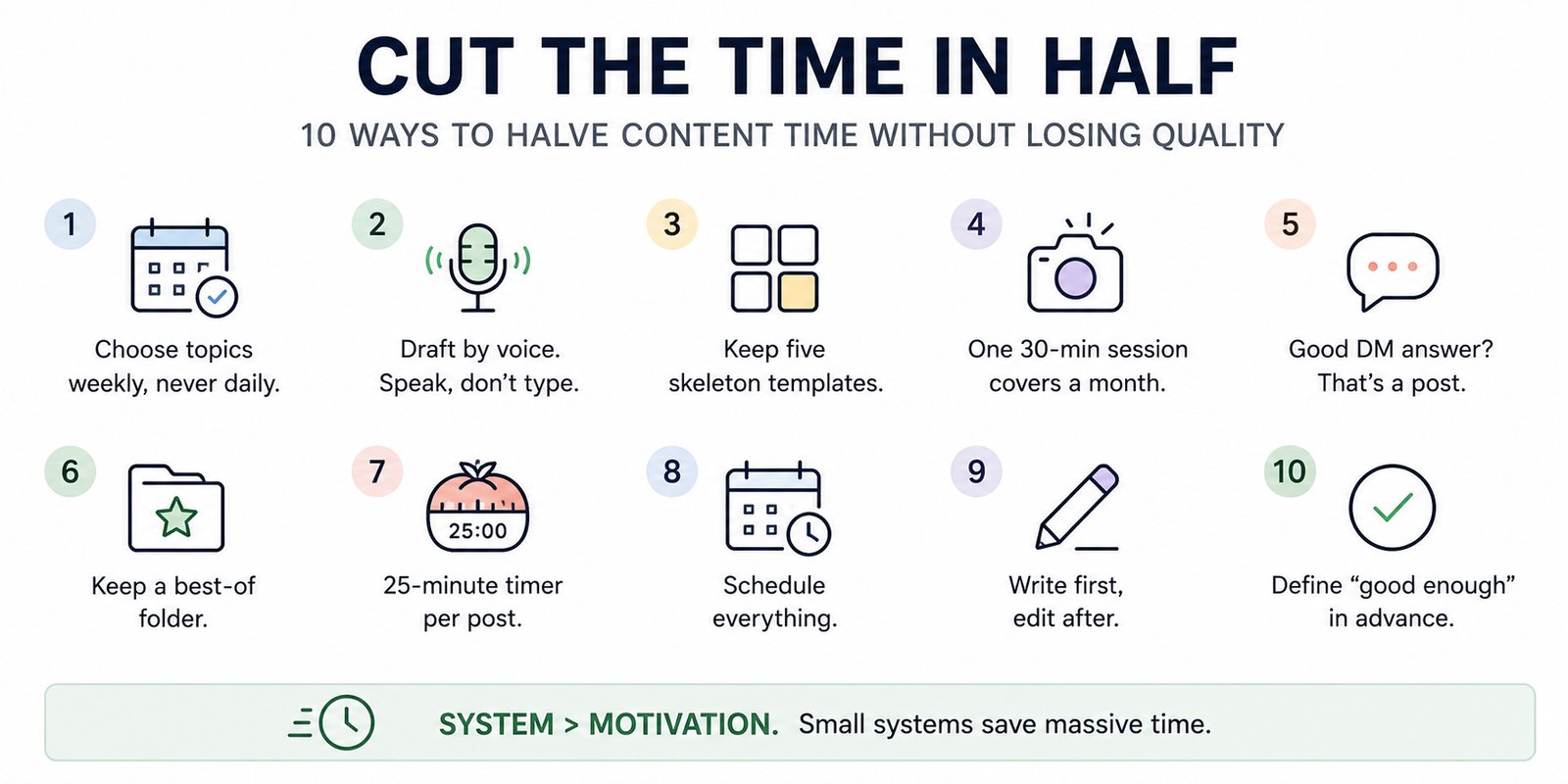
The fix that actually holds: replace “send me materials” with a two-minute voice note ritual. Every Monday, the client records what’s new: what arrived, what a customer asked, what went wrong and got fixed. Voice works where forms fail because clients already live in voice messages, and because spoken language carries their real vocabulary, the exact phrases that make content sound like them instead of like a content calendar template.
One two-minute note reliably contains a week of posts. It also compounds your knowledge file: every note adds facts, cases and objections you didn’t have to schedule a call to collect.
Where AI belongs in the workflow, and where it doesn’t
The honest division, learned the expensive way:
AI is excellent at the compressible mass: drafts in a defined voice, variants to choose from, format conversion between platforms, images built from the client’s real photos, short vertical video. It is structurally bad at the incompressible part: strategy, approvals, community, the client relationship, and judgment about what a business should say. Managers selling judgment have nothing to fear from AI. Managers selling only production hours are competing with it already.
The trap with generic chatbots is that they’re stateless. Every chat starts from zero, so you spend the saved writing time re-briefing the model on the client, and the output still defaults to the internet’s average. What changes the economics is per-client memory, and that is precisely the gap Laspi was built to close. Each client lives as a separate project with its own compounding memory (offers, cases, objections, audience) and a voice profile derived from their real posts and notes. The client’s Monday voice note goes straight in; out comes the weekly plan, platform-native copy for each network, images from their actual photos, and reels with voiceover. You review, adjust and publish, and no client passwords ever change hands. One of our first users, a social media manager, put the effect simply: the work got about five times lighter.
As an AI tool for social media managers, the pricing math matters more than the features: plans start at €19 per month per project, which is a rounding error inside any reasonable retainer.
The new math of retainers
Rerun your own numbers with production compressed. If the twelve production hours per client drop to three or four hours of review and direction, the same working week holds two to three times the clients, or the same roster suddenly returns your evenings. Three ways to spend the difference, all legitimate: take more clients at current prices, keep the roster and enjoy the margin, or upsell the freed hours as strategy and ads management, the work that was always more valuable than caption-writing anyway.
The point of tooling was never to write faster captions. It was to move you up the value chain of your own business.
FAQ
How many clients can a social media manager handle? Solo and full-service, most managers cap out around five to seven, because production hours are the binding constraint. Change the production model and the number moves; the strategy and relationship hours are what remain genuinely yours.
Will AI replace social media managers? It replaces production hours, not judgment. The realistic risk profile: managers selling only execution get squeezed; managers selling strategy, taste and client trust get leverage.
How do I get clients to actually send content? Stop asking for content and ask for two minutes of voice every Monday: what’s new, what clients asked, what changed. It’s the lowest-friction ritual we’ve found, and it doubles as ongoing discovery.
What’s the minimum toolkit for managing multiple clients? A per-client knowledge file, a derived voice profile, and a weekly input ritual. A disciplined spreadsheet-and-folders version works. Laspi is that system automated, with the generation layer attached.
The cheapest way to test the math: set up one client in Laspi’s free week, run their Monday voice note through it, and compare the hours against your current workflow. The first week is free, no card, full-quality output.