Women in Tech Scholarships: Stop Chasing the Full-Time Degree Filter and Lead with Proof of Work
Women in tech scholarships exist, but many require full-time bachelor's enrollment, which excludes career changers pursuing QA, BA, or cybersecurity through certificates and self-study. Instead of seeking more lists, focus on flexible scholarships and build applications around concrete proof of work like projects, certificates, and documented contributions.
Open three scholarship pages and look for the same line. Full-time enrollment. Bachelor’s program. Accredited institution. By the third tab, the pattern stops feeling like bad luck and starts looking like architecture. This is the part nobody says clearly enough to women trying to move into tech from adult life. The money exists. More than $2 million in funding is available across tech scholarships for women, and some awards go as high as $25,000. Yet a large share of that money is built for a specific applicant: someone already inside a traditional academic pipeline, usually full-time, usually degree-seeking, usually easy for a committee to classify in one checkbox. If you are learning QA at night, studying business analysis between shifts, or moving into cybersecurity through certificates and projects, the usual advice lands with a thud. "Apply for scholarships" sounds generous until the form asks for the one thing you do not have: formal enrollment on the approved path. The obvious objection comes fast. If millions of dollars are available, surely the main problem is awareness, not structure. Maybe people just need to search better, apply earlier, and stop assuming scholarships are only for eighteen-year-olds on a campus tour. That would be comforting. It would also be wrong. Look at one of the best-known examples. Google's Women Techmakers Scholars program offers a $10,000 award, renewable, with a typical deadline of December 1. For the right applicant, that is serious help. But it requires full-time enrollment in a bachelor's program. A woman taking a part-time route, a bootcamp route, or a self-taught route can admire the number and still be shut out by the first eligibility line. The barrier is not the absence of money. The barrier is that the door was built for somebody else. The same pattern shows up in cybersecurity. The ESET Women in Cybersecurity Scholarship is available in Canada, with a deadline of 08-Apr-2026, and it is for Bachelor applicants. That narrows the field twice. First by geography, then by degree status. Outside Canada, excluded. Pursuing industry certifications instead of a bachelor's degree, excluded. A scholarship can be perfectly real, generous, and still useless to the woman reading the page at 11:40 p.m. after work. This matters because career switches into tech rarely look tidy. The idealized scholarship candidate moves from school to school. Real life moves sideways. A woman may start in operations, customer support, accounting, teaching, healthcare administration, or retail. She may choose QA because it offers a practical entry point. She may choose business analysis because she already translates between teams for a living. She may choose cybersecurity because she wants a field where disciplined study compounds into employable skill. None of that fits neatly into "full-time undergraduate."
The Hidden Filter: Why Most Scholarships Exclude Career Changers
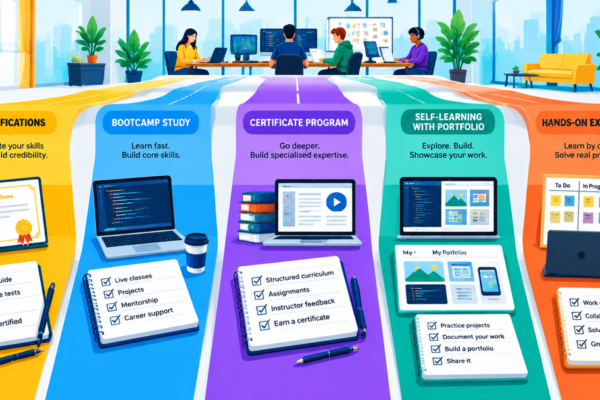
That is why the common mistake is so costly. People assume the problem is a shortage of aid, so they spend weeks searching for bigger lists. The lists get longer, the requirements stay the same, and the discouragement starts to feel personal. It is not personal. It is a filtering problem. The fix begins with a different question. Stop asking, "How many scholarships are there for women in tech?" Ask, "Which of these scholarships can recognize the path I am actually on?" That shift sounds small. It changes everything. Once you ask the right question, one sharp fact stands out. Some scholarships are starting to move away from the degree-only model. The Women in Auto Tech Scholarship offers $5,000, with a deadline of April 10, 2026. It is one of the few examples here that does not explicitly require a four-year degree. That single omission matters more than the headline amount. It signals a different logic. The committee is not using enrollment status as the main proof that you belong in the field. That is the turn most applicants miss. They keep reading scholarships as if the deciding factor were identity plus paperwork. Woman, admitted, enrolled, done. But committees that relax strict degree requirements need another way to judge seriousness. They look for proof of work. Proof of work is less glamorous than a diploma and often more persuasive. A working test case suite says more about your readiness for QA than a generic statement about loving technology. A documented requirements analysis for a mock product says more about your business analysis instincts than a transcript from an unrelated major. A home lab write-up, a security fundamentals certificate, or a clearly explained project can show commitment in a way no checkbox can. This is where non-traditional candidates have more leverage than they think. A traditional student often competes with institutional prestige. A career switcher can compete with evidence. If your path is unconventional, your application has to make that path legible. The committee cannot infer effort from enrollment status, so you show the work directly. That means replacing vague ambition with artifacts. Not "I want to work in cybersecurity someday," but a completed course certificate plus notes on what you learned. Not "I am interested in QA," but a project where you tested a site or workflow and recorded bugs, edge cases, and expected behavior. Not "I think I would be a good business analyst," but a portfolio piece that breaks down a process, identifies stakeholders, and maps requirements. Notice what this does psychologically. The scholarship page stops being a verdict on whether you count. It becomes a matching exercise. Some doors are locked by design. Fine. Walk past them. Others are half-open, but they only open fully if you arrive carrying evidence. For women entering QA, BA, or cybersecurity from outside a degree program, practical training matters because it gives you material to show, not just skills to claim. If you are building toward one of those paths, structured learning in QA & Test Engineering, Business Analysis, or Cybersecurity from Zero can help you produce the kind of concrete outputs scholarship reviewers can evaluate. The useful part is not the course label. It is the portfolio trail you can pull from it. The temptation here is to treat every application as a writing exercise. It is not. It is an evidence assembly exercise. Committees read essays, yes, but essays mainly frame the proof. The proof does the heavy lifting. So the smartest next step is not to collect ten more scholarship bookmarks. Pick one scholarship with flexible eligibility and build your application around three proof-of-work items. Just one scholarship. That is the whole move. Choose the one whose rules do not instantly disqualify your path. Then list three items you already have or can finish soon: one project, one contribution, one certificate. A QA learner might use a bug report portfolio, a test plan, and a course certificate. A future business analyst might use a process map, a requirements document, and a relevant course completion record. A cybersecurity applicant might use a lab exercise write-up, a security fundamentals certificate, and a small documented project. Three pieces are enough to change the feel of an application from hopeful to grounded. Do it this week. Open one flexible scholarship, paste its eligibility rules into a document, and underneath them write the three proof-of-work items you will submit or create. The old model asks whether you fit the scholarship. The better question is whether your work can walk through the opening that already exists. A lot of women are standing outside the wrong door, staring at the "full-time bachelor's" sign as if it were a judgment on their future. Often it is just a design choice on a form. Bring your work, find the doors built to recognize it, and the hallway looks different.