How to Become a QA Engineer with No Experience: The Test Log Strategy
To become a QA engineer with no experience in 2026, start by creating a test log: find bugs in an app you use, document them with steps to reproduce, expected vs. actual behavior, and screenshots. This demonstrates practical testing skills to employers. Target entry-level manual testing roles that explicitly offer training, and use platforms like LinkedIn to share your work directly with QA leads to bypass automated filters.
Two years. That’s how long one person on the r/gamedev subreddit spent wanting to switch into QA before finally asking strangers how to do it. Two years of watching job postings, reading requirements, and feeling the door was locked from the inside. And in those two years, the entry-level bar barely moved. Postings still asked for experience. Tools like Selenium and Jira still appeared under "required." The catch-22 held firm. No experience, no job. No job, no experience.
But the people who broke through in that same window didn’t wait for a permission slip. They built something a hiring manager could look at. They built a test log.
A test log is a deceptively simple artifact: a document that shows you found a real bug, in a real product, and wrote it up like a working tester would. Not a hypothetical. Not a course project where the bug was planted for you to find. A live bug, in an app you actually use, documented with steps to reproduce, expected versus actual behavior, and a screenshot. One page. The claim isn’t that this trick unlocks every door. It’s that most candidates bring nothing at all, so the one who brings a test log becomes the obvious choice by default.
What the Job Postings Actually Say
Start with the numbers visible right now. According to Remote Rocketship, at least 17 remote entry-level QA tester jobs explicitly did not require experience as of the search date. That’s not a huge number, 17 jobs across an entire platform, but it tells you something important. The "no experience" category exists. Employers are categorically willing to look at people without a testing resume.
On ZipRecruiter, no-experience QA tester jobs in California were listed at $32 to $58 per hour. That’s a wide range, and the high end suggests that once you’re in, the pay scales quickly. Some of those listings don’t require a degree. Some companies explicitly state they are willing to train you. At least one internship, at Phoebus Tecnologia in Brazil, fully remote, involves assisting in software testing and automation, with no prior experience demanded.
The picture is not a mirage. Real openings exist. The problem is that 17 jobs on one board, plus a scattering of internships and train-on-the-job positions, still add up to far fewer spots than people who want them. The Reddit poster with the two-year stall is not unusual. The paralysis is normal. The question is what makes someone stand out when the door cracks open.
The Thought Experiment: Two Candidates Walk In
Imagine you’re a QA lead with one junior slot to fill. Two applications arrive.
Candidate A sends a resume listing an online course in software testing, familiarity with Selenium and Jira, and a brief cover note saying they’re "passionate about quality." The resume looks like forty others you’ve seen this week.
Candidate B sends the same resume, same course, same tools, but attaches a link to a Google Doc. The doc contains three bug reports for a moderately popular productivity app. Each report includes the app version, the device used, clear steps to reproduce, the expected behavior, the actual behavior, and a screenshot with the defect circled. One of the bugs is a subtle edge case: the sort order breaks when you add a filter, then remove it, then add a different one. The writing is plain and precise. No jargon. No fluff.
Which candidate gets the interview?
The thought experiment isn’t about proving Candidate B always wins. It’s about what Candidate B demonstrates. A bug report like that shows three things simultaneously: you understand what a bug is, you can communicate it to a developer without wasting their time, and, most crucially, you did the work without being asked. That third signal cuts through. It says: this person already acts like a tester.
Where the Naive Rule Fails
The naive rule most people follow is: get a certificate first, then apply. The logic feels sound. A certificate proves you studied the material. It fills the blank space on the resume. For some regulated industries, it’s non-negotiable.
But QA is not a regulated industry. No one is legally required to hold an ISTQB certification to file a bug report. The certificate proves only that you passed a test about testing, a different skill from actually finding defects in software you didn’t write. A hiring manager knows this. They’ve seen certificate-holders freeze when handed a real build and told to explore it. They’ve also seen self-taught testers with no formal training tear an app apart in twenty minutes.
The counterexample is the candidate who got the certificate, applied to fifty jobs, and heard nothing back. It happens constantly. The certificate isn’t worthless, it can teach you vocabulary like "boundary value analysis" and "equivalence partitioning" that helps you think systematically. But it doesn’t differentiate you. A test log does.
The Limitations of a Test Log
But Here’s the Catch
Grant the obvious objection: a test log is not a guaranteed fast track. If the claim were that simple, everyone would do it and the advantage would evaporate. The truth is messier.
First, 17 remote entry-level jobs on one platform is a thin sample. The broader market for no-experience QA roles is real but not abundant. You may need to apply to many more than 17 jobs, across multiple platforms, over weeks or months. The test log improves your odds per application. It doesn’t make the odds 100%.
Second, some companies filter by keyword before a human sees your materials. If their applicant tracking system rejects anyone without "1+ years QA experience" on the resume, your test log link may never be opened. That’s a genuine failure mode. The countermove is to target companies that explicitly state they train new testers, or to reach out to QA leads directly on platforms where a human will see the link.
Third, the test log strategy works best for certain kinds of QA roles, manual testing, exploratory testing, game testing, where the primary skill is observation and clear communication. If the role is heavily weighted toward test automation, a test log alone won’t land it. You’d need to show code. But for the entry-level positions that say "no experience required," manual testing is usually the starting point.
The non-obvious catch is that a test log doesn’t just prove your eye for quality. It proves your eye for quality on a specific product, which means you’ve implicitly chosen an industry. File bugs against a mobile game, and game studios will take you more seriously than fintech companies will. File bugs against a banking app, and the reverse is true. The choice of product is itself a signal about where you want to work. That’s leverage if you use it deliberately, and a misdirect if you don’t.
Building Your First Test Log
Building the Thing
The mechanics are straightforward. Pick an app you use daily, something you know well enough to notice when it misbehaves. Use it with attention. When something breaks, write down exactly what you did, in order. Note the device, the OS version, the app version. Describe what you expected to happen and what actually happened. Take a screenshot. Put it all in a document.
One report is enough to start. One report proves you can do the core task. But three reports, across different features or severity levels, show range. A minor UI glitch. A functional error where a button doesn’t respond. A data problem where the wrong number displays. Each demonstrates a different layer of observation.
Courses exist that teach the concepts and tools, Selenium for browser automation, Jira for bug tracking, and they are useful. But the test log doesn’t require any of them. A Google Doc and a screenshot tool are sufficient. The point is to produce evidence, not to master a stack before you’ve started.
How a Test Log Compares to Other Paths
What This Actually Compares To
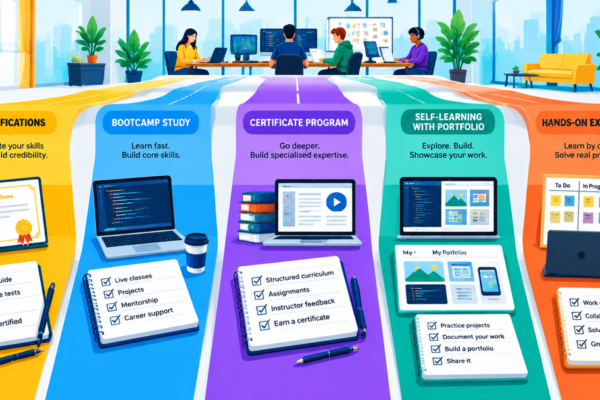
The honest comparison isn’t between a test log and nothing. It’s between a test log and the other paths people take to break in: certifications, networking, internships, bootcamps.
A certification costs money and time, and at the end you have a line on your resume. It may help you pass a keyword filter. It won’t, by itself, convince a human that you can find bugs.
An internship, like the remote one at Phoebus Tecnologia, is excellent if you can get it. It gives you real experience, mentorship, and a credential. But internships are competitive, and you’re back to the application pile.
A bootcamp can work, especially the ones with job placement pipelines. But they are expensive, and quality varies sharply.
A test log costs nothing but attention. You can build it this weekend. The tradeoff is that it requires you to trust your own observational instincts before anyone has validated them. That’s psychologically harder than it sounds.
The "pick this if" ending writes itself: if you have money and time, do the certificate and the bootcamp and the internship, stack every advantage. If you don’t, or if you’ve already done those things and still aren’t getting calls, build the test log. It is the highest-leverage single action available to someone with no experience, because it replaces a claim about your ability with a demonstration of it.
What would you put in your first bug report if you opened your most-used app right now and looked at it not as a user, but as someone who expected it to work perfectly and found a crack?