How to Get Into Tech Without a Degree: 5 Practical Paths Built Around Proof
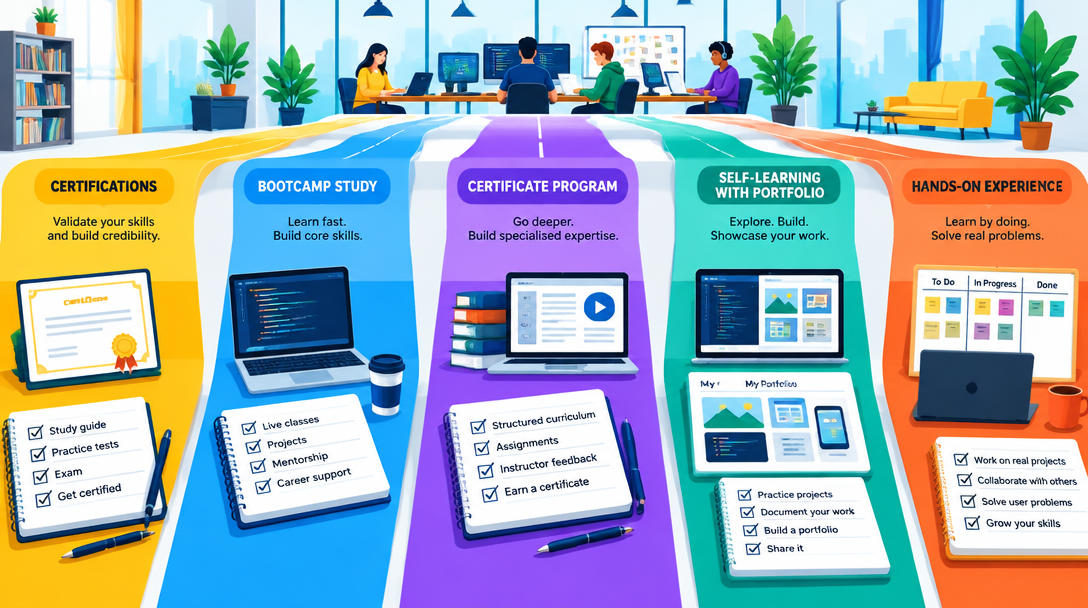
You can get into tech without a degree by choosing a path that produces clear proof of skill: certifications, a bootcamp, a structured certificate program, self-learning paired with a portfolio and resume, or direct tech experience. The common thread is not the credential itself. It is the evidence behind it.
The old assumption is simple: no degree, no tech job. The newer reality is more practical.
For entry-level tech roles, demonstrated skills can matter more than a transcript. Hiring has shifted toward skills assessments and portfolio reviews in many cases.
That changes the question. Instead of asking how to replace a degree, ask how to build proof.
The five paths below are different ways to create that proof. Pick one main route, then add supporting evidence around it.
1) Certifications that validate core skills
- Build a certification path around the area you want to enter. Certifications can validate your skills by showing that you meet industry standards and can apply knowledge in real-world scenarios. Concrete examples mentioned in the sources include CompTIA A+ and Network+ for IT and networking, CISSP for cybersecurity, PMP for project management, and cloud certifications such as AWS or Google Cloud.
2) Bootcamps that focus on practical work
- Use a bootcamp when you want intensive, short-term training in a specific area. In the supplied sources, bootcamps are described as practical and project-based, and as programs that teach key skills in areas like coding, UX design, or data science so you can move from beginner level to stronger competency.
3) Structured certificate programs
- Choose a certificate program if you want a more structured route with a clear completion point. The sources describe certificate programs as structured programs from companies or universities that award a certificate on completion and demonstrate expertise in specific, job-ready skills.
4) Self-learning with a portfolio and resume
- Follow a self-learning route only if you pair it with visible output. The sources list self-learning, a great portfolio, and a strong resume together as a real route into tech without a degree. That combination matters because hiring may rely on what you can show through assessments or portfolio review.
5) Direct experience that proves you can do the work
- Get tech experience wherever you can document real work. The supplied material explicitly lists experience as one of the ways to prove yourself without a degree. Treat every task, project, or hands-on responsibility as evidence you can later point to in applications, interviews, assessments, and portfolio discussions.
A degree is one kind of signal. It is not the only one.
If hiring is moving toward proof, your job is to create proof on purpose. Choose one path, finish it well, and make the result easy to verify.
FAQ
Do I need a degree to start in tech?
Not always. The supplied sources state that tech jobs without a degree exist if you can prove yourself through experience, certifications, boot camps, self-learning, and a strong portfolio and resume.
What matters more than the credential itself?
The evidence behind it. One source says the credential matters less than the proof sitting behind it, with hiring often shifting toward skills assessments or portfolio reviews.
What can certifications show?
According to the sources, certifications can show that you meet industry standards and can apply your knowledge in real-world scenarios.
What is a bootcamp in this context?
The supplied material describes a bootcamp as an intensive, short-term program that teaches key skills in a specific area, such as coding, UX design, or data science.

You may also like


Entry-Level Remote IT Jobs: Proof Beats ‘No Experience’