The Shortest Path Into Cybersecurity for Women Is Not the Loud One
For many women starting a cybersecurity career, the shortest path is not through technical roles but through governance, risk, and compliance (GRC). GRC roles value skills like writing, coordination, and pattern recognition that many career changers already have. A certification like Security+ can help get past HR filters, but the core strategy is to map existing skills to GRC job descriptions.
Twenty-four. That is how many women you are likely to find in a room of a hundred cybersecurity workers, according to WomenHack. Now put a second number beside it: $90,000, the median starting salary reported by SANS Technology Institute for graduates of its Applied Cybersecurity Certificate, and $120,000 for its bachelor’s graduates. A field can be underrepresented and well paid at the same time. That is exactly why the usual advice does so much damage.
The Problem with the Usual Advice
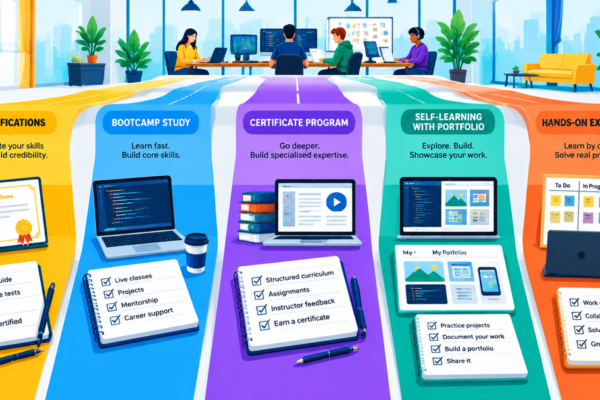
The damaging part is not that people recommend learning technical skills. Cybersecurity does need technical people, and some women will thrive in threat hunting, penetration testing, digital forensics, or security engineering. The problem is the narrow script. Ask how to break in, and the answers often arrive in a familiar stack: learn networking, learn Linux, get Security+, maybe get CEH, maybe a bootcamp, maybe capture-the-flag competitions, maybe spend months proving you can think like an attacker. WomenHack lists those routes because they are common. Common is not the same as best.
The better question is smaller and more useful: where is the shortest path between the skills you already have and the part of cybersecurity that will actually hire you?
Why GRC Is the Overlooked Entry Point
For many women changing careers, that path runs through governance, risk, and compliance, usually shortened to GRC. A Reddit discussion from women in tech career changers put it plainly: governance, risk, and compliance is a sector to consider, and getting at least Security+ can help get past HR filters. That pairing matters. One piece gets your resume through the gate. The other points you toward work that often values judgment, writing, coordination, and pattern recognition as much as command-line fluency.
This is the part most career advice misses. It treats cybersecurity as if the whole field begins in a terminal window. In practice, a lot of security work begins in a spreadsheet, a policy review, a vendor questionnaire, an audit request, a risk register, or a meeting where somebody has to translate a technical issue into a business decision. Those jobs are not side doors. They are the plumbing that keeps security programs functioning.
Two Versions of the Same Job Search
Imagine two versions of the same job search.
In the first, you do what the internet tells everyone to do. You spend six months trying to become "technical enough." You compare Security+ to CISSP to CEH. You watch videos on packet analysis. You try a capture-the-flag challenge. You feel behind within a week, because every forum has someone younger, louder, and deeper into the weeds. Every new concept creates three more concepts. You are not learning nothing. You are learning without a target.
In the second, you pull up ten job descriptions with titles like GRC analyst, security compliance analyst, third-party risk analyst, or security awareness specialist. You notice the verbs. Review. Document. Assess. Coordinate. Communicate. Track remediation. Support audits. Interpret requirements. Work with stakeholders. Those verbs are less glamorous than "exploit" or "reverse engineer," but they are concrete. They also look suspiciously like work many career changers have already done in operations, project management, teaching, law, healthcare, finance, customer support, administration, or business analysis.
That is the spark people miss. Cybersecurity contains jobs built around defending systems, but it also contains jobs built around making organizations legible to themselves. GRC sits in that second category. If you have ever had to gather evidence, explain a process, keep people on deadlines, spot inconsistencies, write clearly, or ask sharp follow-up questions, you are closer to useful security work than you think.
This does not mean GRC is soft or trivial. It means the entry barrier is different.
A naive rule says you need deep technical expertise first, then you can move into cybersecurity. That rule fails the moment you look at how organizations actually run. A company can have strong engineers and still fail an audit, mishandle risk, ignore a vendor exposure, or miss a compliance deadline because nobody is translating between technical teams and business obligations. Security breaks in boring ways long before it breaks in cinematic ways.
Certifications: Tactical, Not Identity
Take certifications. They matter, but not in the grand, identity-defining way online discussions pretend. According to the Reddit advice above, getting at least Security+ can help get past HR filters. That is a useful, modest claim. Security+ can act as a sorting key for recruiters. It can show you know the broad vocabulary. It can reduce friction. What it cannot do, by itself, is tell you where you fit best in the field.
That is why people get stuck. They treat the certificate as the career plan. Then they collect enough terms to feel overwhelmed, but not enough direction to feel employable.
The smarter use of certification is tactical. If a GRC posting asks for basic security knowledge, Security+ may be worth pursuing because it helps you clear the first screen and gives you a frame for conversations with technical teams. If the posting emphasizes documentation, policy, audits, vendor risk, and stakeholder communication, the certificate supports your story. It does not have to become your whole personality. CISSP and CEH show up often in lists of common credentials too, according to WomenHack, but common does not mean first. Someone moving from another career should care less about prestige and more about sequence.
Why the Gender Gap Persists
Here is where the mismatch in those opening numbers starts to resolve. Women are only about 24% of the cybersecurity workforce, but the field still pays well, as SANS reports in its graduate salary data. Why does that gap persist? Partly because the public image of cybersecurity keeps steering entrants toward the loudest, most technical, and most visibly masculine corners of the field. If the mental picture is a hoodie, a shell prompt, and years of uninterrupted technical obsession, many capable people assume they are looking at someone else’s job.
GRC changes that picture because it reveals what the field actually needs: people who can reduce risk in real organizations. Not just people who can break things in a lab.
The Catch: GRC Is Not Effortless
There is a catch, and it matters. GRC is accessible, but it is not effortless. If you hear "lower technical barriers" and translate that as "no technical understanding required," you will walk into interviews unprepared. A GRC analyst still needs to understand basic security concepts. You need to know what access control is, why patching matters, what phishing does, why vendors create risk, what evidence looks like, and how a policy connects to a control. You may not need to configure firewalls on day one, but you do need enough literacy to ask intelligent questions and catch bad answers.
This is why the best entry strategy is a braid, not a single thread. Learn enough technical material to speak the language. Use one broad certification, often Security+, if it helps with filters. Then spend most of your energy on a niche where your existing strengths already create value. GRC is one of the clearest such niches because the work naturally rewards communication, organization, analysis, and persistence.
The internet often treats those abilities as secondary. Hiring managers do not. Somebody has to chase evidence for an audit. Somebody has to read a requirement and map it to an internal process. Somebody has to tell a busy team that their workaround creates risk, then get them to fix it without turning the meeting into a fight. Those are not decorative skills. They are operating skills.
This site’s own offerings include a Cybersecurity Track, along with QA & Test Engineering, Career Tracks, and a Career Advisor. If you want structured study, that is the direct in-house place to start. But structure alone is not enough. You also need contact with actual people in the field, because career changes stall in isolation.
Community as Part of the Search
That is where community stops being a nice extra and becomes part of the job search itself. Women in CyberSecurity, known as WiCyS, offers mentorship and scholarships, according to WomenHack. CyberDegrees also notes that nonprofit groups, foundations, and companies offer scholarships for women in cybersecurity, and argues that getting more women into tech starts with education. Education here should not be read narrowly as classes. It includes social education too: learning how people talk about roles, what hiring managers care about, which job titles are adjacent, and how real resumes get interpreted.
WomenHack job fairs add another practical layer. According to WomenHack, their tech job fairs are free for candidates and feature 15 to 20 employers at each event. That number matters because it turns a vague hope into a repeatable tactic. One event can expose you to more hiring conversations than months of cold applications. WomenHack is a job fair platform, not a research institution, so treat its workforce and event numbers as platform-based information rather than universal labor market truth. Still, as a place to meet employers, the format solves a real problem: many career changers do not need more anonymous advice, they need more live contact.
The same caution applies to salary data. SANS Technology Institute reports the median starting salary of its Applied Cybersecurity Certificate graduates at $90,000 and its bachelor’s graduates at $120,000. Those figures are powerful because they show that cybersecurity can be financially viable. They are also school-reported outcomes from its own graduates, not a guarantee for every entrant in every market. SANS also says it knows the employment status of 99% of its upper division undergraduates, which suggests close tracking, but the right lesson is still directional, not magical. Cybersecurity pays real money. You do not need to pretend every role starts at six figures to justify the switch.
A Concrete First Step
Once you stop searching for the perfect all-purpose answer, the path gets less mystical.
Start with one GRC job description. Not twenty, not a whole tab forest, one. Read it slowly. Look for repeated tasks. Does it ask for policy review, risk assessment, documentation, audit support, control testing, stakeholder communication, or vendor management? Then map three of your existing skills directly to those requirements. If you worked in teaching, maybe you already know how to explain complex rules clearly and keep records. If you worked in operations, maybe you already know how to track deadlines and gather evidence. If you worked in healthcare or finance, maybe you already understand regulated environments and the cost of mistakes.
Write those matches down in plain language. "I have communication skills" is weak. "I regularly gathered documentation from multiple teams, checked it for gaps, and delivered it on deadline" is stronger. "I handled sensitive information and followed formal procedures" is stronger. "I translated policy changes into practical steps for non-specialists" is stronger. GRC hiring lives on verbs like those.
Then test your map with another person. If you do not have a mentor yet, that is exactly why groups like WiCyS matter. Join a community, attend an event, ask for feedback on your skill mapping, and compare your interpretation with how practitioners describe the role. A peer group also works. The point is to stop guessing alone.
Women do not need a pep talk about belonging in cybersecurity. They need a better map. The field keeps advertising one dramatic entrance and hiding the side gate where many careers actually begin. GRC is that side gate for a lot of people: close to the road, less crowded, and attached to work that organizations cannot stop needing.
So here is the useful question to carry into tonight, not someday. When you read one GRC job description, which three things have you already done that look more like security work than you ever gave yourself credit for?